Category: Uncategorized

  • Your Body Is Not Broken: Talking Bio Coding and Chronic Pain with Rosabel Unscripted

    Your Body Is Not Broken: Talking Bio Coding and Chronic Pain with Rosabel Unscripted

    Rosabel Unscripted podcast artwork featuring host Rosabel Zohfeld and the tagline “Neuroscience Explained Simply”.

    “I hate my body!”, “My body is against me!” “What’s wrong with me?”

    I hear these things from clients time and time again when they first walk through the door of my clinic. I understand, They have been suffering with chronic pain, PTSD, chronic stress symptoms and the cycle of symptoms and failed treatments can feel never ending.

    Yet this is far from the perspective I adopt when I look at recovery and I am not alone.

    I recently joined Rosabel Unscripted to discuss chronic pain, my recovery from fibromyalgia & PTSD and the thinking behind Bio Coding™.

    At the heart of our conversation was a shift that has shaped my work: from asking, “Why is my body against me?” to asking:

    “What is my body adapting to?”

    I sat down with Rosabel Zohfeld to explore this further. I had been on the podcast circuit for about a month, and this was one of the conversations I was most looking forward to. Neuroplasticity and its role in recovery are a particular passion of mine, so when we connected through PodMatch, I was excited to discuss these ideas with someone working directly in neurology.

    Rosabel is a neurology nurse practitioner, neuroscience educator and author. Drawing on her clinical experience with people and families navigating neurological conditions, she makes the brain and nervous system accessible and understandable. That combination of clinical knowledge and clear communication made this a particularly valuable opportunity to explore my approach.
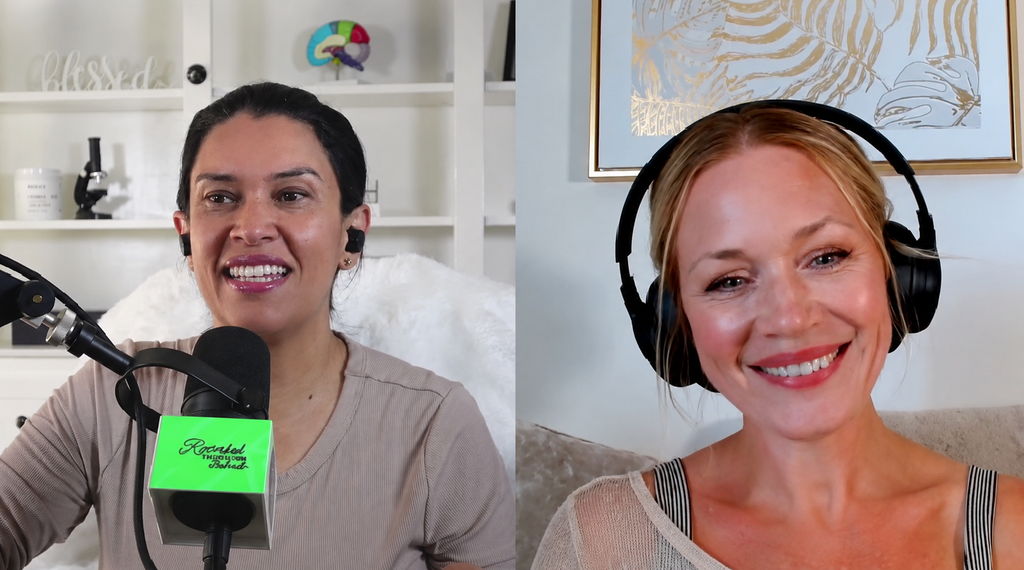
    Rosabel Zohfeld and Hollyanna Vellichor in a split-screen podcast interview discussing chronic pain recovery and Bio Coding.

    Here are some important ideas we explored

    • The body is not against you—it’s trying to continue. Understanding symptoms means considering how the body has adapted to demands, rather than assuming every uncomfortable response represents a separate failure.
    • Load versus resources. I look at the cumulative demands on a body alongside the resources available to manage them—including sleep, nourishment, support and opportunities for recovery. Identifying where demands exceed those resources is a starting point for supporting recovery.
    • All branches of the tree lead to the same roots. Pain, fatigue, poor sleep, anxiety and digestive difficulties may appear to be separate problems and are often treated individually. But they belong to one interconnected body. We look at how those symptoms relate and what may be contributing to them—a holistic approach in the truest sense of the word.
    • The language of the body. Movement is fundamental to how the body functions—even thinking involves the movement of ions and neurotransmitters as nerve cells communicate. Our conversation explored movement beyond gym work and exercise: spontaneous, variable, body-led movement, and how mechanical input influences cells and the nervous system.
    • Recovery should build autonomy. My aim is to help people with Chronic pain and other complex illnesses understand their own responses and make informed choices without becoming dependent on a practitioner. They should be the director of their health, choosing how practitioners and treatments support them—not merely passive recipients of care.

    Why I look at the outliers

    My own recovery from fibromyalgia changed the questions I asked.

    What bridges the gap between the theory and lived reality of recovery?

    I wanted to understand the people who recovered from conditions they had been expected to live with. What was different about them? What had changed? What helped? What could their experience teach us?

    Averages tell us something useful about populations, but we can become fixated on them as definite outcomes for individuals. They cannot tell us everything about the person sitting in front of us. An individual recovery does not establish a universal solution, but it gives us valuable information worth investigating.

    As practitioners, clinicians and therapists, we need to remain humble. The body has complex systems for adaptation and repair, and our understanding of their capabilities—and limitations—is still developing.

    That curiosity continues to shape Bio Coding.

    Rosabel’s reflection on our conversation

    After our interview, Rosabel wrote an incredible companion article. She is perhaps the first person to grasp Bio Coding so thoroughly that reading her explanation felt as though she had developed the model herself.

    She brought its principles together with intelligence and clarity, translating them into small, meaningful changes readers can begin making in their own lives. She understood both the philosophy and its practical relevance.

    For me, that reflects more than clinical experience. It reveals an insightful, pioneering mind—someone willing to ask what the body may be capable of beyond the boundaries we currently understand. That shared curiosity made our conversation particularly meaningful.

    Read Rosabel’s article: Your Body Is Not Broken—7 Powerful Truths That Transform Chronic Pain Recovery.

    Watch the full conversation

    Watch my interview with Rosabel Unscripted on YouTube.

    What can you take from this into your own recovery?

    You don’t need to change everything at once. Start with one question and one manageable action.

    • Change the question. When you catch yourself thinking, “My body is against me,” ask instead, “What demands is my body responding to—and what support might it need?” Notice whether that changes how you approach the problem.
    • Look at your load and resources together. Make two short lists: what drains you and what replenishes you. Include physical demands, work, responsibilities, sleep, nourishment and support. Where could you reduce one demand or strengthen one resource?
    • Notice variation. When are symptoms quieter? What is different on those days? A better day may offer useful clues—not proof of a cause, but something worth exploring.
    • Choose one small change. Ask for help with a task, protect a break or make a demanding routine more manageable. Notice what happens to your comfort, energy and ability to do things that matter to you.

    Recovery should not become another exhausting job. The starting point may be less about doing more and more about giving your body room to respond.

    Explore Bio Coding

    If these questions resonate with your own experience of persistent pain or fatigue, you are welcome to enquire about Bio Coding and discuss whether my approach could be a useful part of your support.
  • Performing “Stillness”

    Performing “Stillness”

    Many people mistake stillness for relaxation. Discover how trauma, the freeze response and nervous system regulation can change the way the body moves and heals.

    Nervous system shut down disguised as peacefulness

    Performing Stillness –

    when relaxation is really just a freeze response


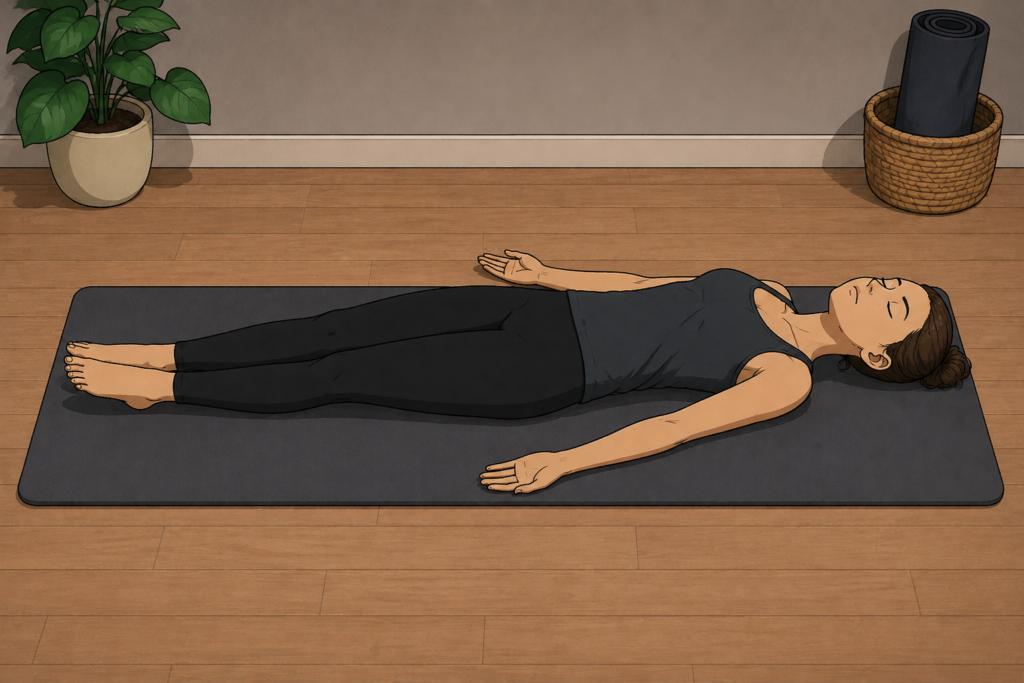
    Many people assume that if someone is lying perfectly still during meditation or yoga, they must be deeply relaxed.

    In my experience, that isn’t always true.

    Sometimes stillness is peace.

    but it can also be protection.

    What Is “Performing Stillness”?

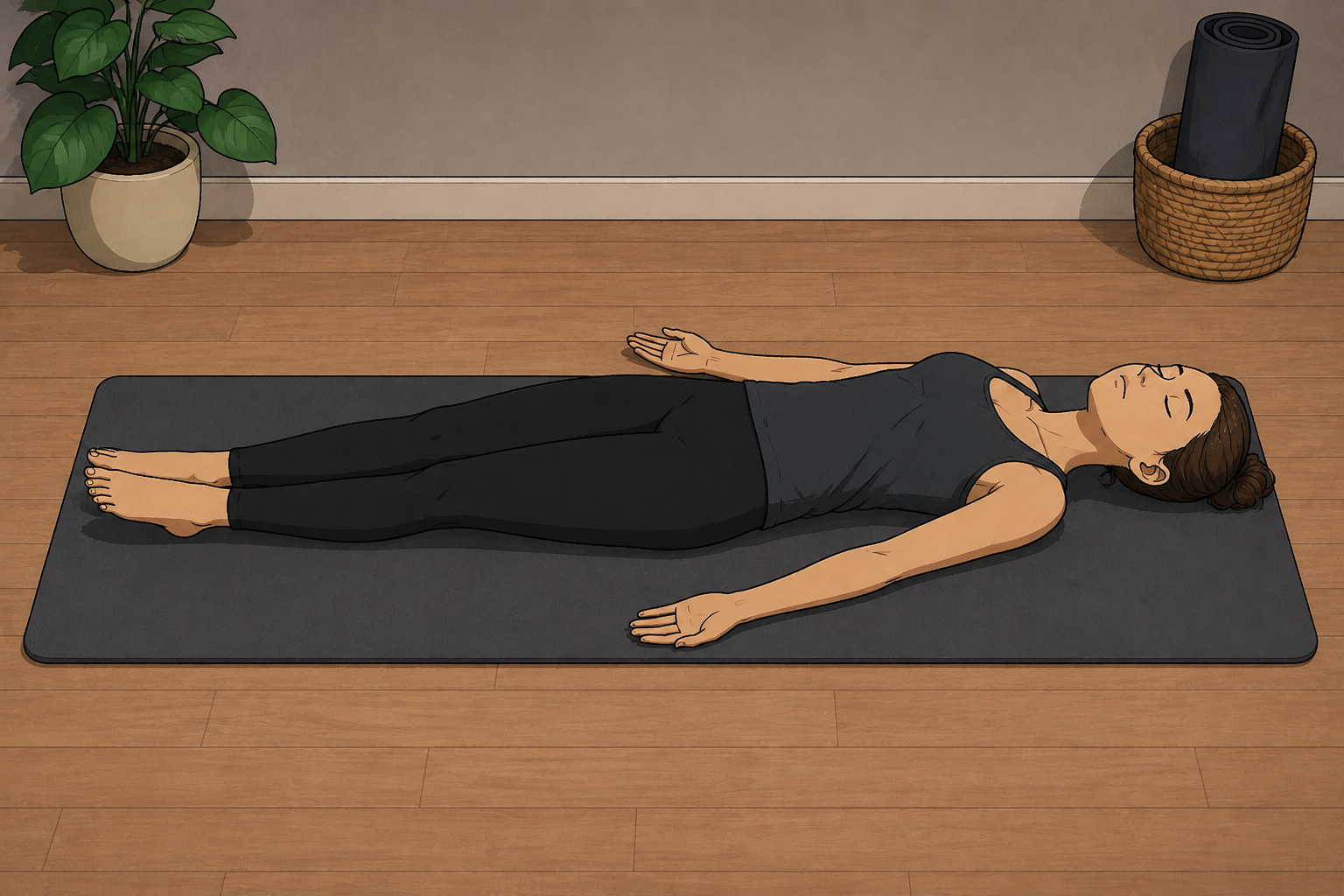
    Often in yoga classes I notice people lying perfectly still -their palms face upwards, their fingers are carefully arranged into “yoga hands”, their legs are straight, their face looks peaceful.

    It’s almost as though everyone is quietly saying,

    “Look how relaxed I am.”

    I know this because I used to do exactly the same thing.


    My Experience of Trauma and Stillness

    For years I believed I was good at relaxing.

    I could empty my mind.

    I could remain completely still.

    I thought that meant I had mastered relaxation.

    Looking back, I now realise something very different was happening.

    I wasn’t relaxed. I was stuck in freeze response.

    Like many people who have experienced prolonged stress or trauma, my body had learned that staying still was the safest option available.

    It looked like calm but really it was protective shutdown.


    Why the Body Wants to Move

    Watch very young children.

    • They wriggle.
    • They stretch.
    • They explore.
    • They twitch.

    Movement is completely natural.

    Then school begins and they are told:

    “Sit still.”

    “Stop fidgeting.”

    “Don’t move.”

    Over time we often learn to override the body’s spontaneous behaviour.

    From a physiological perspective, life itself is movement.

    • Muscles contract.
    • Blood circulates.
    • Breathing changes continuously.
    • Electrical signals travel through the nervous system.
    • Even a thought depends upon movement between neurons.

    Movement isn’t something the body does occasionally.

    Movement enables us to exist at all.


    What I Notice in Clinical Practice

    One of the observations that has fascinated me most is this:

    When the body genuinely feels safe, it often wants to move.

    Not dramatically.

    Tiny movements.

    A toe twitches.

    The jaw adjusts.

    The pelvis shifts.

    The shoulders reorganise.

    The body appears to make small spontaneous corrections without conscious effort.

    Rather than seeing these movements as something to suppress, I have become interested in whether they may represent the nervous system organising itself when enough safety is present.


    A Simple Exercise

    Try this.

    Find somewhere comfortable.

    Then silently say to yourself:

    “Body, feel free to move.
    Feel free to fidget.
    Feel free to twitch.”

    Then wait.

    Don’t try to create movement.

    Don’t stop movement.

    Simply observe.

    Sometimes nothing happens.

    Sometimes the body shifts slightly before becoming still again.

    Imagine you’ve invited an electrician into your home to inspect the wiring.

    You don’t tell them which sockets to test.

    You simply step aside and allow them to do their work.

    Approach your own body with the same curiosity.


    Why Permission Matters

    I think explicit permission is important for two reasons.

    First, it begins to challenge years of conditioning.

    Many of us repeatedly heard:

    “Sit still.”

    “Stop fidgeting.”

    “Keep still.”

    Giving ourselves permission reverses that message.

    Secondly, permission may help communicate to the nervous system that movement is no longer dangerous.

    Safety is rarely created by forcing the body.

    It is often created by providing the conditions and permission.


    What If Nothing Happens?

    Many people find that nothing happens during the first attempt.

    That doesn’t concern me.

    If the body has spent years suppressing spontaneous movement, it may take time before that permission is trusted.

    Sometimes the relationship between mind and body has become fractured.

    The mind controls.

    The body complies.

    Neither listens to the other.


    Rebuilding Communication Between Mind and Body

    Much of my work focuses on helping people rebuild that relationship.

    Before asking the body to heal, I often find it is more helpful to restore communication.

    Almost like couples therapy.

    The first step isn’t solving every problem.

    It’s helping two sides begin listening to one another again.


    Final Thought

    Perhaps the question isn’t:

    How do I become still?

    Perhaps the better question is:

    How do I create enough safety that my body no longer needs to stay still?

    Sometimes recovery begins not by controlling the body more…

    …but by finally giving it permission to speak.

    If you want to know more, book a free telephone consultation to discuss how I can help you.


  • The Chronic Stress spiral

    The Chronic Stress spiral

    How It Damages Cell Structure and Prevents Recovery (and How to Fix It)

    An underestimated factor in recovery: how chronic stress impacts cellular structure — and potentially prevents effective healing.

    So what can we do? Read on…

    An old text becomes relevant

    An old text suddenly came to mind: Acts 15:29 — “you must abstain from … the meat of strangled animals.”

    In a recent vivid dream, I kept asking: “What is the structural difference between the meat of strangled animals versus those humanely killed?” I repeated the question until two glass slides appeared. Blurry images of cells began to form. A strange dream for a vegetarian.

    When I woke up, the question still burned in my mind, so I started researching it.

    The basic answers were fascinating. In humane slaughter, workers stun the animal and bleed it quickly. This allows the muscles to use up their glycogen, producing lactic acid that lowers the pH. The meat stays tender and pink. In strangulation, the animal dies in extreme stress without proper bleeding. The struggle burns up the glycogen, the pH stays high, and the meat becomes dark, firm, dry — and spoils faster.

    But my dream wasn’t really asking about chemistry or texture. It wanted to know about architecture — what actually happens to the cells themselves.

    How stress affects the living cells

    What I discovered felt surprisingly relevant to my work.

    In a high-stress death, rapid changes while the tissue is still warm break down proteins and the internal lattice inside muscle cells. Water shifts into the wrong spaces. The neat geometric arrangement of the cytoskeleton becomes distorted and disordered. The more the animal suffers, the more its cellular architecture changes.

    This got me thinking.

    The angle of healthy function

    I work with people who have complex chronic conditions, long-term pain, and cancer. Over the years developing Bio Coding™, I’ve grown increasingly interested in geometry at the cellular level — how symmetry and oblique angles support coherent signalling, wave functions, and stable low-energy structures.

    You can see this principle clearly with ocean waves: waves that cross at oblique (slanted) angles usually pass through each other with little disruption. Waves that meet head-on or at right angles tend to break and scatter.

    The same pattern appears throughout nature — in DNA helices, the spiralling of the heart, and the microscopic structure of microtubules in the brain. Oblique symmetry supports smooth, uninterrupted flow.

    The pathology of disrupted geomery

    So what happens when chronic stress disrupts this geometry in our bodies?

    Research shows that chronic stress:

    • Destabilises microtubules
    • Causes Tau proteins to detach, leading to bundling and collapse of the lattice
    • Makes dendrites atrophy and change shape
    • Creates denser, fibrotic patterns in muscle cells

    All of this distorts cellular signalling and leaves cells more vulnerable.

    Is repair possible?

    The big question is: If we’ve experienced trauma or chronic stress, can we help the body restore that lost symmetry and obliqueness?

    The answer, surprisingly, is yes — and one of the most powerful tools we have is movement.

    Movement generates mechanical forces that help cells reorganise their internal scaffolding through mechanotransduction. This doesn’t require forced exercise. In my practice, I get the best results from spontaneous, variable, cross-pattern, and corrective movements that naturally emerge in Bio Coding™ sessions. These allow the body to explore and rehearse healthier patterns.

    In short: when given the right conditions and permission, the body knows how to restore coherence and reduce symptoms.

    Food for thought

    I’ll write more soon about the practical side — how Bio Coding and the other pillars of this work support this restoration process.

    But the dream has stayed with me. Maybe the ancient instruction to avoid the meat of strangled animals wasn’t only about ritual purity. Maybe it pointed to something deeper: how stress and suffering leave their mark on living tissue.

    Thanks for reading! Subscribe for free to receive new posts and support my work.

  • BioCoding™ Packages & Pricing: Reset, Recode, Renaissance Explained

    BioCoding™ Packages & Pricing: Reset, Recode, Renaissance Explained

    BioCoding™ is a pioneering somatic therapy designed for people who have tried everything else — and are finally ready for lasting, measurable change.

    Unlike traditional bodywork methods, BioCoding™ primes the body to access it’s own spontaneous repair movements, restoring calm, clarity and reducing distress.

    Why BioCoding™ Works

    Living with chronic conditions such as fibromyalgia, autoimmune disease, or long-term stress often creates patterns of tension, anxiety, and disrupted sleep. BioCoding™ treats the body as a self correcting system and provides the environment and opportunity for more optimal adaptation, restoring balance and coherence from the inside out.

    Instead of temporary relief, clients experience deep, nervous-system-level transformation and a better relationship with their body that continues long after the session ends.

    The Science Behind the Method

    The BioCoding™ program is combined with lifestyle medicine protocols, de-hypnotising from limiting beliefs, and core structure coaching and education for maximum success in recovery.

    The unique therapy itself combines assisted movements, priming movements – all leading to trigger the body into spontaneous movement. This precision makes BioCoding™ scalable, repeatable, and measurable as well as fast.

    Created Through Lived Experience

    BioCoding™ was founded by Hollyanna Vellichor, whose journey through fibromyalgia, PTSD, and complex family trauma led her to research the nervous system in depth. Her lived experience—combined with thousands of clinical hours—shapes a method that is both compassionate and evidence-based.

    A Therapy for Lasting Change

    BioCoding™ is not a quick fix. It is a structured, six-month process that works with the brain’s natural timeline for neuroplasticity. Packages include assessment, guided sessions, integration protocols, subconscious rewiring, and ongoing support.

    Who It’s For

    BioCoding™ may be right for you if you are experiencing:

    • Chronic pain or inflammation
    • Trauma or emotional overload
    • Autoimmune conditions
    • Nervous system dysregulation
    • Cycles of anxiety, overwhelm, or fatigue

    Ready to Experience the Difference?

    Book your free consultation and discover how your body can return to balance, strength, and resilience.

  • Who Is Hollyanna Vellichor? Founder of BioCoding™ Somatic Therapy

    Who Is Hollyanna Vellichor? Founder of BioCoding™ Somatic Therapy

    Author Holly Anne Relief From Symptoms anxiety support, emotional burnout , mental health awareness

    Hollyanna Vellichor is the creator of BioCoding™, a breakthrough somatic science that helps the body access its own repair mechanisms through precise, geometric micro-movements.

    A Journey Built From Real Experience

    Her path began when her mother was diagnosed with terminal cancer. To support her, Hollyanna completed five qualifications in just two years while raising two children. During this time, she faced her own diagnoses of fibromyalgia and PTSD, which deepened her commitment to understanding how the body processes pain and trauma.

    Raised in a high-control religious group and later shunned after leaving, Hollyanna rebuilt her life from the ground up. She became the living experiment for her research — proof that the body can recover even after complete physical and emotional collapse.

    A Method Grounded in Science and Compassion

    Hollyanna has spent over a decade studying bodywork, hypnotherapy, yoga, meditation, and somatic coaching. Combined with cutting-edge nervous system science, these disciplines formed the foundation of BioCoding™.

    Her work is:

    • Rigorous
    • Measurable
    • Trauma-informed
    • Rooted in lived experience

    Thousands of hours with clients have produced consistent results, including relief from chronic pain, improved emotional regulation, and deeper mind-body connection.

    A Recognised Voice in Lifestyle Medicine

    Hollyanna is an ambassador for lifestyle medicine with the British Society of Lifestyle Medicine (BSLM), contributing patient perspective to the future of healthcare.

    Her Mission

    To offer a safe, structured pathway for people who feel they’ve tried everything — and finally want to feel whole again.

    Work With Hollyanna

    If you’re ready for meaningful change, her 6-month BioCoding™ programs offer an evidence-based route to long-term transformation.

  • BioCoding™ Therapy Explained: How It Restores Nervous System Balance

    BioCoding™ Therapy Explained: How It Restores Nervous System Balance

    BioCoding™ is a pioneering somatic therapy designed for people who have tried everything else — and are finally ready for lasting, measurable change. Unlike traditional bodywork methods, BioCoding™ identifies hundreds of repeatable repair movements mapped directly to nervous system function.

    Why BioCoding™ Works

    Living with chronic conditions such as fibromyalgia, autoimmune disease, or long-term stress often creates patterns of tension, anxiety, and disrupted sleep. BioCoding™ activates the body’s inherent repair codes, restoring balance and coherence from the inside out.

    Instead of temporary relief, clients experience deep, nervous-system-level transformation that continues long after the session ends.

    The Science Behind the Method

    BioCoding™ blends geometric micro-movement analysis, neuroplasticity, somatic therapy, and trauma physiology. Each movement pattern corresponds to a specific nervous system function, allowing the body to repair not through force — but through precision.

    This precision makes BioCoding™ scalable, repeatable, and measurable in ways that other somatic methods are not.

    Created Through Lived Experience

    BioCoding™ was founded by Hollyanna Vellichor, whose journey through fibromyalgia, PTSD, and complex family trauma led her to research the nervous system in depth. Her lived experience—combined with thousands of clinical hours—shapes a method that is both compassionate and evidence-based.

    A Therapy for Lasting Change

    BioCoding™ is not a quick fix. It is a structured, six-month process that works with the brain’s natural timeline for neuroplasticity. Packages include assessment, guided sessions, integration protocols, subconscious rewiring, and ongoing support.

    Who It’s For

    BioCoding™ may be right for you if you are experiencing:

    • Chronic pain or inflammation
    • Trauma or emotional overload
    • Autoimmune conditions
    • Nervous system dysregulation
    • Cycles of anxiety, overwhelm, or fatigue

    Ready to Experience the Difference?

    Book your free consultation and discover how your body can return to balance, strength, and resilience.