
Many people mistake stillness for relaxation. Discover how trauma, the freeze response and nervous system regulation can change the way the body moves and heals.
Performing Stillness –
when relaxation is really just a freeze response
Many people assume that if someone is lying perfectly still during meditation or yoga, they must be deeply relaxed.
In my experience, that isn’t always true.
Sometimes stillness is peace.
but it can also be protection.
What Is “Performing Stillness”?
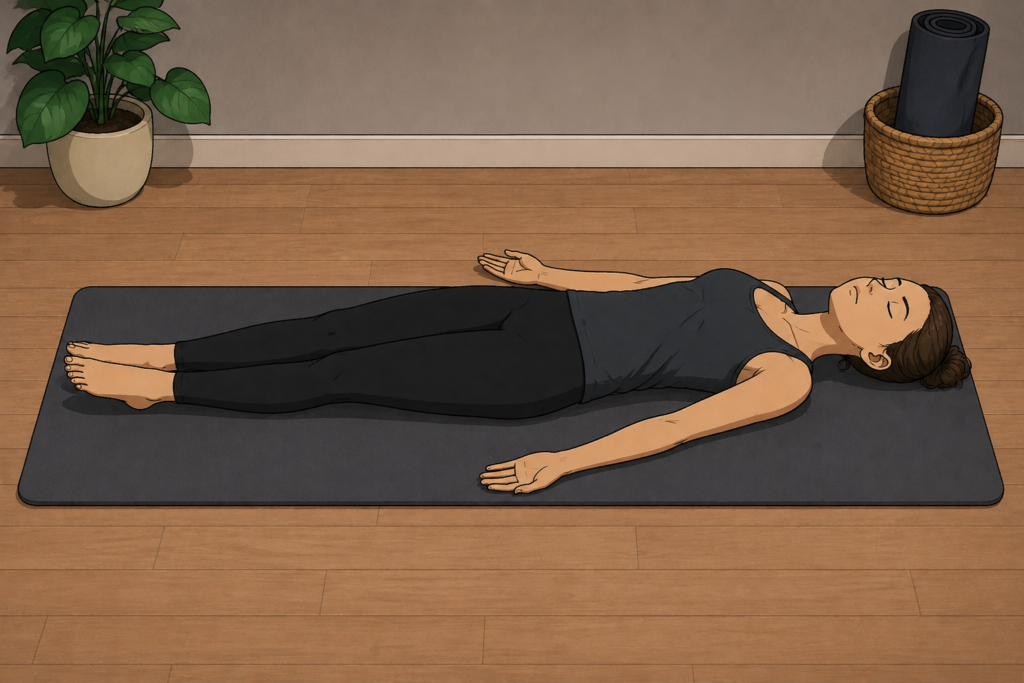
Often in yoga classes I notice people lying perfectly still -their palms face upwards, their fingers are carefully arranged into “yoga hands”, their legs are straight, their face looks peaceful.
It’s almost as though everyone is quietly saying,
“Look how relaxed I am.”
I know this because I used to do exactly the same thing.
My Experience of Trauma and Stillness
For years I believed I was good at relaxing.
I could empty my mind.
I could remain completely still.
I thought that meant I had mastered relaxation.
Looking back, I now realise something very different was happening.
I wasn’t relaxed. I was stuck in freeze response.
Like many people who have experienced prolonged stress or trauma, my body had learned that staying still was the safest option available.
It looked like calm but really it was protective shutdown.
Why the Body Wants to Move
Watch very young children.
- They wriggle.
- They stretch.
- They explore.
- They twitch.
Movement is completely natural.
Then school begins and they are told:
“Sit still.”
“Stop fidgeting.”
“Don’t move.”
Over time we often learn to override the body’s spontaneous behaviour.
From a physiological perspective, life itself is movement.
- Muscles contract.
- Blood circulates.
- Breathing changes continuously.
- Electrical signals travel through the nervous system.
- Even a thought depends upon movement between neurons.
Movement isn’t something the body does occasionally.
Movement enables us to exist at all.
What I Notice in Clinical Practice
One of the observations that has fascinated me most is this:
When the body genuinely feels safe, it often wants to move.
Not dramatically.
Tiny movements.
A toe twitches.
The jaw adjusts.
The pelvis shifts.
The shoulders reorganise.
The body appears to make small spontaneous corrections without conscious effort.
Rather than seeing these movements as something to suppress, I have become interested in whether they may represent the nervous system organising itself when enough safety is present.
A Simple Exercise
Try this.
Find somewhere comfortable.
Then silently say to yourself:
“Body, feel free to move.
Feel free to fidget.
Feel free to twitch.”
Then wait.
Don’t try to create movement.
Don’t stop movement.
Simply observe.
Sometimes nothing happens.
Sometimes the body shifts slightly before becoming still again.
Imagine you’ve invited an electrician into your home to inspect the wiring.
You don’t tell them which sockets to test.
You simply step aside and allow them to do their work.
Approach your own body with the same curiosity.
Why Permission Matters
I think explicit permission is important for two reasons.
First, it begins to challenge years of conditioning.
Many of us repeatedly heard:
“Sit still.”
“Stop fidgeting.”
“Keep still.”
Giving ourselves permission reverses that message.
Secondly, permission may help communicate to the nervous system that movement is no longer dangerous.
Safety is rarely created by forcing the body.
It is often created by providing the conditions and permission.
What If Nothing Happens?
Many people find that nothing happens during the first attempt.
That doesn’t concern me.
If the body has spent years suppressing spontaneous movement, it may take time before that permission is trusted.
Sometimes the relationship between mind and body has become fractured.
The mind controls.
The body complies.
Neither listens to the other.
Rebuilding Communication Between Mind and Body
Much of my work focuses on helping people rebuild that relationship.
Before asking the body to heal, I often find it is more helpful to restore communication.
Almost like couples therapy.
The first step isn’t solving every problem.
It’s helping two sides begin listening to one another again.
Final Thought
Perhaps the question isn’t:
How do I become still?
Perhaps the better question is:
How do I create enough safety that my body no longer needs to stay still?
Sometimes recovery begins not by controlling the body more…
…but by finally giving it permission to speak.
If you want to know more, book a free telephone consultation to discuss how I can help you.